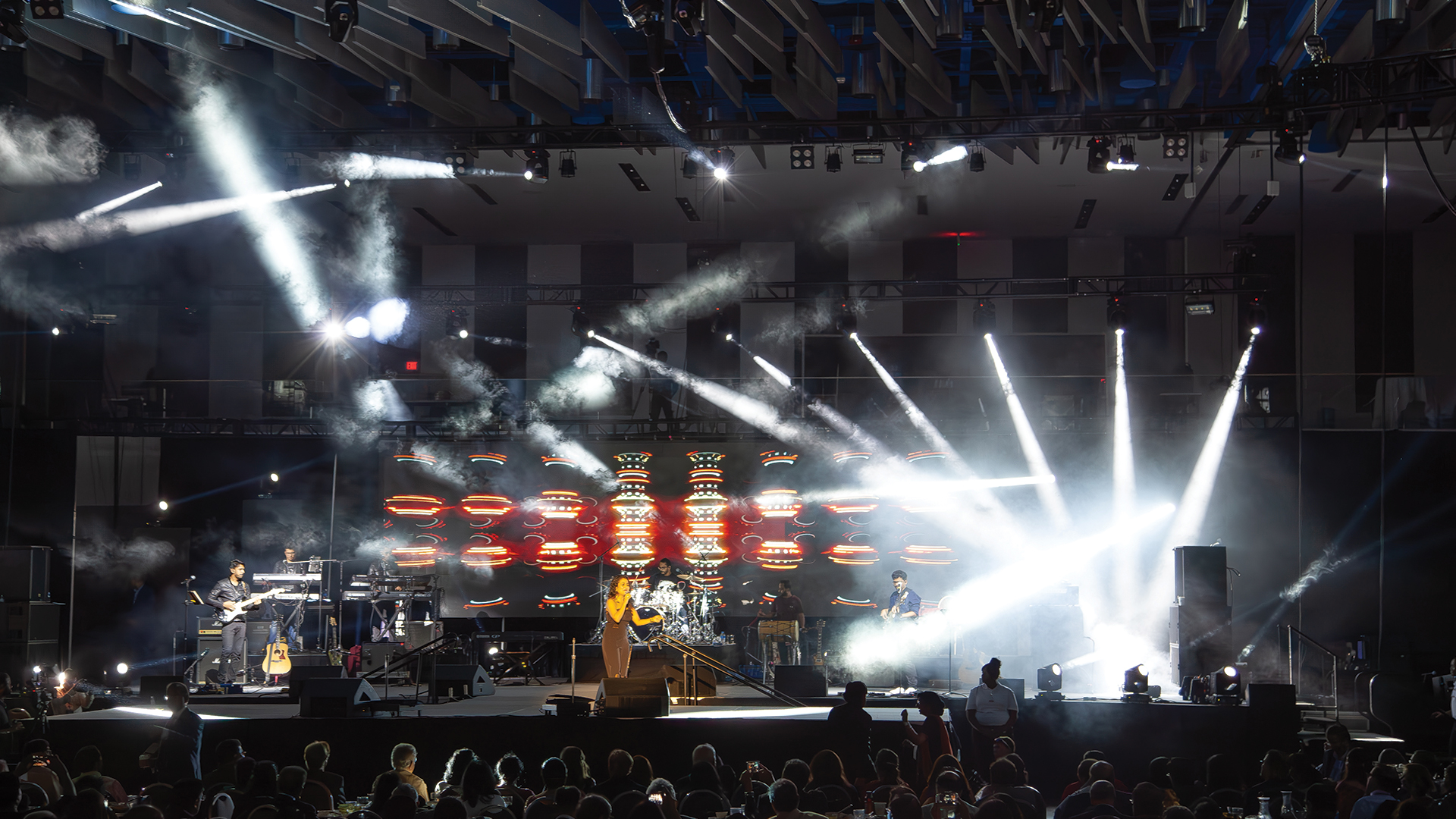
The Uniformity Problem: Every Listener Deserves the Same Bass
In the hierarchy of festival audio engineering concerns, coverage uniformity is simultaneously the most technically demanding challenge and the most commercially consequential. An audience member who pays the same ticket price as the person standing 100 meters closer to the stage should have a fundamentally similar acoustic experience. In the mid-to-high frequency range, modern line array systems from L-Acoustics, d&b, and JBL deliver this uniformity with remarkable consistency across established design methodologies. In the low frequency range — below 200Hz — the physics of subwoofer coverage are far less forgiving, and delivering even bass distribution across a festival field serving 50,000 or 150,000 people requires engineering approaches that have evolved substantially over 150+ festival deployments.
The root cause of uneven low-frequency coverage at outdoor festivals is the interference between multiple subwoofer sources. When two or more subwoofer cabinets operate simultaneously in an outdoor environment without reflective boundaries, their output fields interact to create areas of reinforcement (where waves add constructively) and cancellation (where waves add destructively), producing a field pattern that varies dramatically with position. A listener who happens to be standing in a cancellation null may experience significantly less bass than someone standing a meter away in a reinforcement peak — a variation of 10–15dB that is perceptually enormous. Eliminating these null zones across a 300-meter-deep audience field is the core engineering challenge of large-scale festival subwoofer design.
Distributed Source Architectures: Spreading the Load
The most effective tool for improving bass coverage uniformity is distributed source architecture — placing multiple smaller subwoofer clusters at distributed positions throughout the audience area rather than concentrating all low-frequency sources at the stage. This approach, increasingly adopted at festivals serving over 30,000 attendees, places subwoofer delay positions at 80–100 meter intervals through the field, each contributing low-frequency reinforcement to its surrounding zone. The interference patterns between the distributed sources are less severe than those from a single large array because the distributed architecture reduces the path length differences between sources and any given listener position.
Companies including Britannia Row Productions, Capital Sound, and Clair Global have developed proprietary distributed subwoofer deployment methodologies based on years of festival measurements. Clair Global’s development of the BT-218 touring subwoofer — a compact, high-efficiency cabinet designed specifically for deployment as distributed delay positions — was a direct response to festival operators’ demand for a sub-delay cabinet small enough to be flown on a delay tower structure without exceeding safe structural load limits. The BT-218 pairs with d&b SL-SUBs and L-Acoustics SB28s at the main stage position to create a complete distributed system that can maintain coverage uniformity variation below 6dB across an entire festival field — a specification that would have been aspirational a decade ago but is now achievable in routine practice.
Measurement and Calibration: Proving the Numbers
The shift from qualitative assessment to quantitative validation of festival bass coverage is one of the defining professional developments of the past decade. Where previous generations of audio engineers relied on experienced listening to judge coverage quality, the modern festival audio team uses a measurement microphone array — typically 10–20 omnidirectional measurement microphones positioned throughout the audience area — connected to a central SMAART Software station that captures simultaneous measurements from all positions. This multi-point measurement methodology, sometimes called multiple-input multiple-output (MIMO) measurement, provides objective, position-by-position data on SPL uniformity, frequency response, and low-frequency phase coherence across the entire field before a single audience member arrives.
The measurement data drives real-time adjustment of subwoofer delay and level across the distributed system, using d&b R1 Remote Control or Lake Controller software to apply per-position corrections until the uniformity specification is met. This evidence-based calibration workflow has reduced the festival-to-festival performance variability that plagued large-scale sound reinforcement in the analog era and has given festival operators — and their insurers — a documented proof of due diligence in sound system performance that was not previously available.
The 150-Festival Track Record: Lessons Learned
Across 150+ festival deployments, several insights have become encoded into the best-practice knowledge base of the festival audio engineering community. First: ground coupling is a variable, not a constant — the acoustic impedance of different soil types, moisture conditions, and ground cover affects bass propagation in ways that simulation software does not capture, requiring on-site calibration that accounts for actual ground conditions rather than theoretical models. Second: audience loading significantly changes bass coverage behavior — a field that measures evenly in venue-empty conditions may develop new null zones when 60,000 people absorb and scatter the wavefield differently than the open field does.
Third, and perhaps most consequentially: the relationship between SPL uniformity and perceived quality is non-linear. A field calibrated to within 3dB variation produces a qualitatively superior audience experience that is disproportionate to the numerical improvement over a 6dB-variation system — because bass uniformity below the perception threshold removes the distracting awareness of position-dependency that prevents audiences from fully surrendering to the music. For the festivals and audio companies who have invested in the engineering discipline to achieve that threshold, the audience quality of life improvement is the ultimate return on investment.
