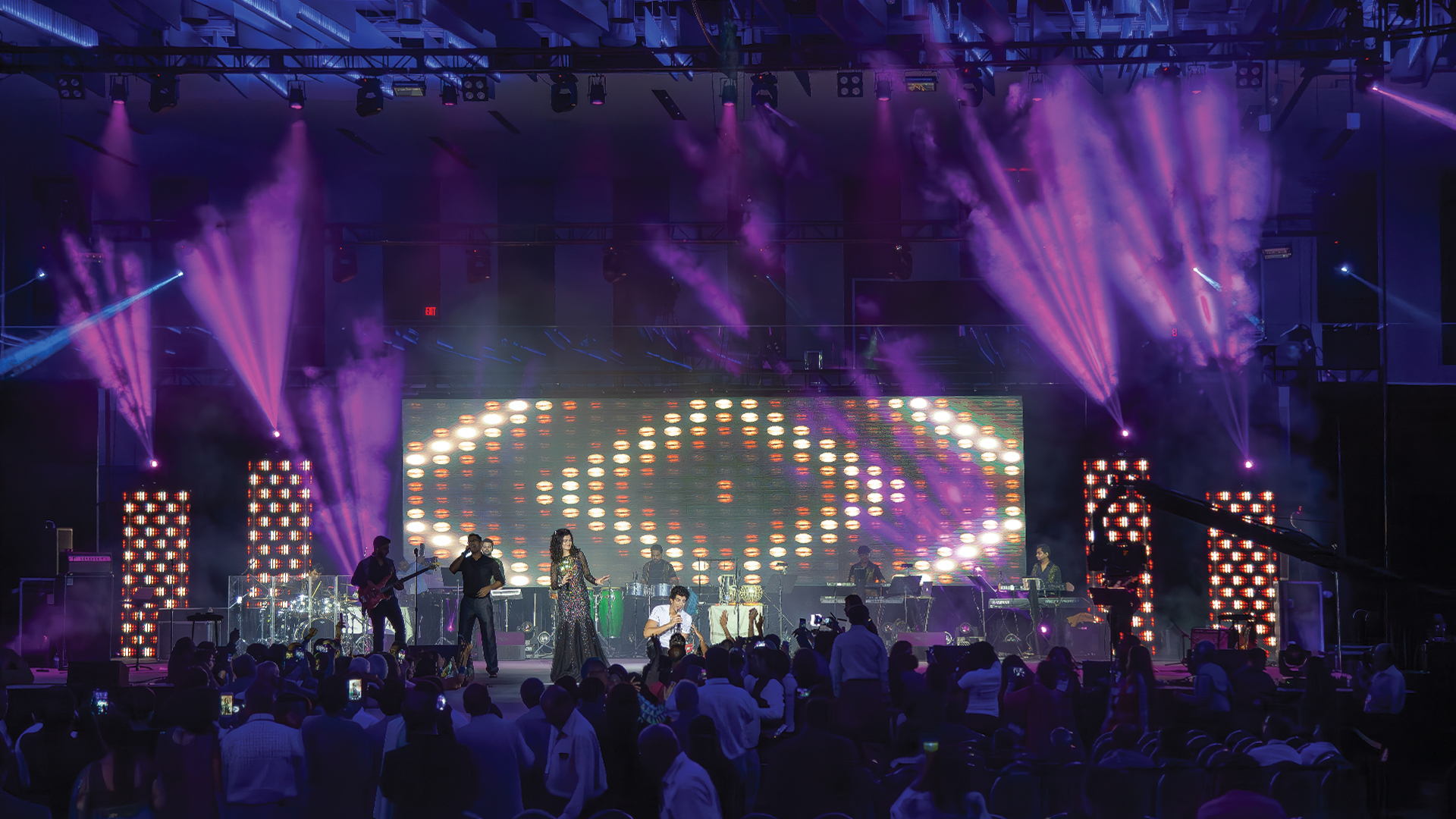
The era of the corporate event stage as a backdrop — a decorative surface behind a podium — is over. The organizations that understand this have converted their annual conferences, product launches, and leadership summits into full-scale immersive productions where the architecture of the digital environment communicates brand authority, innovation, and narrative depth with the same density that a feature film achieves through production design. LED walls are the enabling technology of this transformation, and the companies and production designers who have mastered their deployment are redefining what a corporate stage can mean.
The Economics of Transformation: Why LED Won Over Projection
The transition from front projection to LED as the dominant surface technology in corporate event design between 2012 and 2018 was driven by a compelling economic and performance argument. Front projection in a large ballroom or convention center hall required the elimination of ambient light — an operationally expensive requirement that forced ceiling systems to be covered or removed, house lighting to be eliminated, and the entire environmental ambiance of the space to be sacrificed for sufficient screen contrast. LED walls operate at 1,000 to 3,000 nits of brightness — far outperforming any projector at equivalent cost in ambient-light environments — and can be scaled to any geometry without the throw-distance constraints that projection systems impose. The per-square-meter LED panel cost, which had fallen from approximately $5,000 to under $1,200 for corporate-grade 3.9mm pitch panels by 2018, completed the economic argument.
Surface Architecture: Going Beyond the Flat Wall
The corporate events production designers who transformed the industry’s creative standards are defined not by their use of LED walls as flat display surfaces, but by their treatment of LED as a volumetric and architectural material. Moment Factory’s corporate work — including productions for Microsoft, Ubisoft, and Cirque du Soleil’s corporate division — consistently deploys LED panels as three-dimensional architectural forms: columns, curved surfaces, angular flying panels that create environments rather than backdrops. The LED ceiling — panels overhead, transforming the entire room into a digital canopy — has become a signature element in the most premium corporate event budgets. Absen’s Acclaim series flexible panels and ROE Visual’s Vanish transparent mesh allow curved and shaped LED installations that would have required custom-built inflexible hardware in previous generations.
Content Strategy: What Makes an Immersive Corporate Stage
The distinction between a corporate stage that deploys LED walls and one that deploys LED walls to create an immersive experience lies entirely in the content strategy. Generic stock motion backgrounds — however technically well-executed — do not create immersion; they create wallpaper. Immersive corporate stage design requires content that is architecturally responsive: visuals that acknowledge the physical geometry of the installation, that react to the presence of speakers and participants on stage, and that reinforce the brand narrative through visual language rather than simply displaying the brand logo. Toolbox creative studios, Spinifex Group, and Digital Kitchen are among the production design companies whose content for corporate events has pushed the medium forward. Their common methodology: treating the entire stage architecture as a single canvas, designing content that moves through physical space rather than merely playing on a screen.
Interactive and Sensor-Driven LED Environments
The most progressive corporate LED stage environments are no longer passive displays — they respond to the human beings within them. Sensor-driven LED systems — in which depth cameras (typically Intel RealSense or Azure Kinect devices), IR tracking systems, or LIDAR scanners feed positional data into the media server that drives the LED content — create environments where the physical position and movement of speakers, executives, or audience members directly influences the visual world surrounding them. TouchDesigner pipelines process the sensor data and generate visual responses in real time, with the result that a CEO walking to a specific position on stage triggers a visual transformation across the entire LED architecture simultaneously. Salesforce deployed a version of this technology at its Dreamforce 2022 keynote; BMW used a similar system at a global dealer launch event in Munich.
Technical Specification for Corporate-Grade Immersion
The technical specification that separates a genuine immersive corporate LED experience from a competent conventional deployment begins with pixel pitch selection relative to minimum viewing distance: the standard calculation of viewing distance in meters × 3 = maximum recommended pixel pitch in mm means that a corporate stage with a 15-meter minimum audience distance requires a 3.9mm or tighter pitch. HDR content delivery — enabled by Brompton Technology’s extended bit-depth processing and disguise media servers’ 10-bit output capability — provides the luminance range necessary for visually dynamic content to retain impact across the entire audience viewing angle. Calibrated color uniformity across all panels in the installation — verified with a Konica Minolta CS-100A colorimeter and matched to the brand’s precise Pantone specifications — ensures that a brand’s color identity is reproduced accurately enough for approval by even the most demanding corporate marketing team.
Case Study: Global Tech Company Summit, Barcelona
A technology sector global summit in Barcelona in 2023 — serving 3,000 executive-level attendees across three days — deployed an LED environment that wrapped the stage and room perimeter with 1,800 square meters of Absen Acclaim AC2.5 Pro panels arranged in a continuous curved architecture that eliminated all visible boundaries between stage and audience space. The content system — a disguise GX 2c system running Notch for real-time generative graphics — was programmed with an 8-hour unique visual narrative per day, with no repeating sequences across the three-day event. Post-event audience research, conducted by an independent research firm, found that 87% of attendees cited the visual environment as a primary factor in their perception of the company as innovative — a finding that the company’s CMO cited in a subsequent board presentation on event marketing ROI. The LED environment’s total production cost was $1.2 million; the company’s marketing team estimated the brand positioning value at more than ten times that figure.
Sustainability Considerations: The LED Corporate Event Calculation
The corporate event industry’s accelerating focus on sustainability and environmental impact has created a new evaluation layer for LED wall deployments. LED’s significant advantage over projection — elimination of lamp disposal, lower power consumption per lumen of output — must be weighed against the carbon footprint of shipping large quantities of LED panels internationally for single events, and the embedded energy in the panels themselves. The emergence of regional LED rental inventories managed by companies like PRG, Screenworks, and Video Design Group has begun to address the shipping footprint problem by enabling productions to source panels from proximate regional warehouses rather than transporting them from distant manufacturing or primary storage facilities. Solar-powered LED demonstration events — pioneered by production companies in partnership with festival organizers at Glastonbury and Roskilde — have documented that full-scale LED wall systems can operate on renewable energy with appropriate power infrastructure investment.
AV Production Insights | Professional Series
