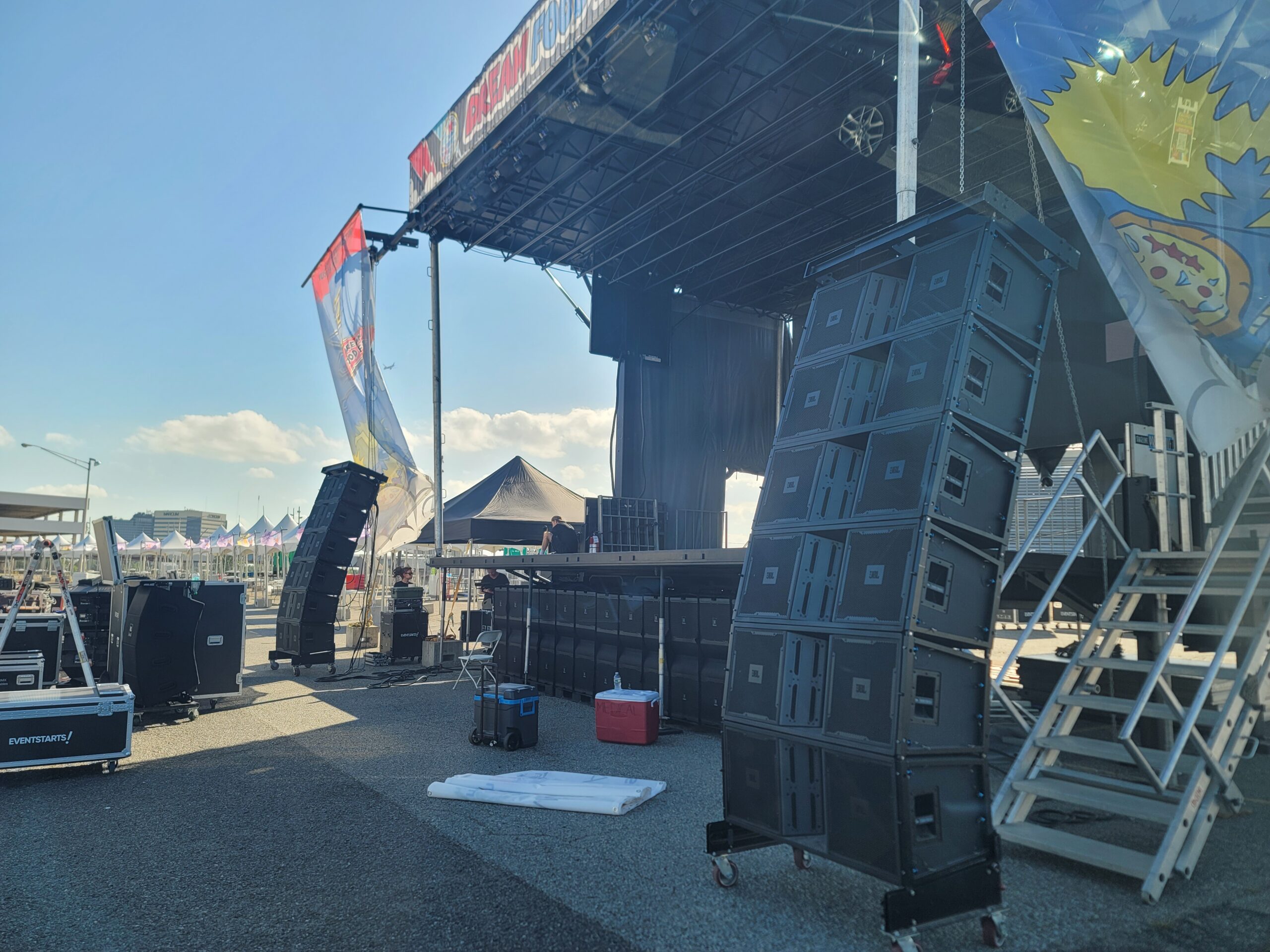
The line array speaker system is the defining technology of modern live sound reinforcement. From intimate 500-person corporate general sessions to 50,000-seat arena concerts, line arrays have replaced the horn clusters, distributed systems, and stacked speaker configurations that dominated live audio for decades. But a line array is not a magic solution — it is a sophisticated acoustic tool whose performance is entirely dependent on the skill, precision, and patience invested in its tuning. A poorly tuned line array in a reverberant hotel ballroom can be acoustically catastrophic, while the same system, expertly configured, can deliver clear, articulate speech reinforcement to every seat in the room.
The Physics Behind Line Array Performance
The theoretical foundation of line array behavior derives from the principle of wave interference. When multiple loudspeaker elements radiate in close proximity with appropriate spacing and time alignment, their outputs combine coherently — creating a cylindrical wave front that maintains level over distance at a rate of approximately 3dB per doubling of distance, compared to the 6dB loss of a point source. This line source behavior is what makes line arrays so effective for long-throw coverage in large rooms. The acoustic physicist Christian Huygens articulated the wave propagation principles that underpin this behavior in the 17th century; it took until the 1990s for V-DOSC manufacturer L-Acoustics to engineer those principles into the first commercially successful modern line array system.
From V-DOSC to Today: The Evolution of Line Arrays
The introduction of the L-Acoustics V-DOSC at the 1994 Woodstock festival is widely regarded as the launch moment of the modern line array era. The system demonstrated, in spectacular fashion, that tightly controlled vertical dispersion and consistent horizontal coverage could be achieved without the lobing artifacts that plagued conventional point source arrays. Within a decade, manufacturers including d&b audiotechnik, Meyer Sound, JBL Professional, Nexo, and QSC had developed their own line array families, fundamentally transforming the touring and installation audio industries.
System Design: Before You Hang a Single Box
Tuning begins in acoustic prediction software — not in the room. Tools like L-Acoustics Soundvision, d&b ArrayCalc, Meyer Sound MAPP XT, and Rational Acoustics Smaart Live allow audio engineers to model the speaker array’s coverage pattern against the room’s architectural dimensions before any equipment is loaded in. A good prediction model accounts for the quantity and splay angles of array elements, the height and hang point of the array, the room’s dimensions and surface materials, and the position of balconies and obstructions.
The array geometry decisions made in this design phase — how many boxes, what splay angles between elements, where the transition from straight to curved sections occurs — determine 80% of your acoustic performance before you’ve adjusted a single processing parameter. No amount of EQ or DSP can compensate for a fundamentally wrong array geometry. This is why production companies that invest in acoustic design software and the engineers trained to use it consistently outperform those that rely on intuition and field guesswork.
Measurement and Verification: The Smaart Workflow
Once the system is flown and powered, real-time acoustic measurement using Rational Acoustics Smaart or SIA SMAART Live becomes the primary tool for verification and correction. The measurement workflow involves placing a calibrated measurement microphone — typically an Earthworks M23 or DPA 4006A — at multiple positions in the coverage area and using a reference signal (pink noise or swept sine) to capture the system’s transfer function: frequency response, phase response, and impulse response at each measurement position.
The objective is coverage consistency — the audience at the front of the room should experience the same tonal balance and clarity as the audience at the rear and sides. Achieving this requires progressive EQ adjustments, delay stack timing, and sometimes array geometry corrections. The process is iterative and time-consuming, which is why professional audio companies schedule substantial pre-show time for system tuning — typically four to six hours for a complex multi-array configuration.
DSP Processing: The System’s Brain
Modern line array systems are inseparable from their digital signal processing (DSP) platforms. L-Acoustics systems use LA Network Manager with LA Series amplified controllers; d&b systems rely on R1 Remote control software and DS10/D80 amplifiers; Meyer Sound uses Galileo Galaxy network platform. These systems provide array-level control over gain, EQ, limiting, delay, and crossover parameters for each segment of the array — allowing the engineer to shape coverage zones, compensate for room boundaries, and protect equipment from overload conditions.
Subwoofer Configuration: The Often-Neglected Variable
Subwoofer configuration is the area where line array tuning most frequently falls apart. The low-frequency behavior of a room is governed by standing wave modes and boundary reinforcement effects that are entirely different from the mid/high frequency behavior addressed by the main array. Techniques including end-fire subwoofer arrays, cardioid subwoofer configurations, and flown subwoofer integration can dramatically improve low-frequency distribution uniformity — but each requires careful time-alignment measurement and often counterintuitive polarity decisions. The engineer who gets subwoofer integration right delivers the visceral, controlled low-frequency experience that audiences remember long after the show. The one who gets it wrong creates a room full of bass nodes where half the audience is deafened and the other half can barely feel the kick drum.
