The Distance Problem: Why the Main Hang Is Never Enough
Physics does not negotiate. Sound propagates from a source at 343 meters per second, losing approximately 6dB of level every time the distance from the source doubles. For a festival main stage serving 75,000 attendees spread across a field 300 meters deep, a main PA hang — however powerful — cannot deliver consistent, intelligible sound to the rear of the audience without a delay tower system that plants reinforcement sources deep within the crowd. This is not a modern insight; it is the foundational engineering reality that has driven delay tower deployment at large outdoor events since the early days of outdoor rock concerts in the 1970s.
What has changed dramatically is the precision of deployment. Early delay systems used analog delay units — tape-based and later BBD (bucket brigade device) chips — that introduced audible coloration and limited delay accuracy to tens of milliseconds. The modern audio delay tower runs on digital signal processing with sub-millisecond timing accuracy, driven by d&b ArrayCalc, L-Acoustics Soundvision, or JBL Performance Manager simulations that predict exactly how each delay position will interact with the main system across every frequency band. The result is coverage that feels seamless — where the delay tower contributes to the listening experience without ever announcing its presence as a separate source.
Siting, Timing, and the Haas Effect
The critical principle governing all delay tower alignment is the Haas Effect — also known as the precedence effect — which describes the psychoacoustic phenomenon whereby the human auditory system localizes a sound to its first-arriving source when two acoustically similar signals arrive within approximately 35 milliseconds of each other. This means that if a delay tower is timed correctly — delivering its output fractionally after the main PA signal arrives at the same physical point — the audience member perceives the sound as coming from the stage, not from the speaker 10 meters to their left. Getting this timing wrong, even by as little as 5 milliseconds, creates a disturbing doubling effect that destroys the spatial coherence of the listening experience.
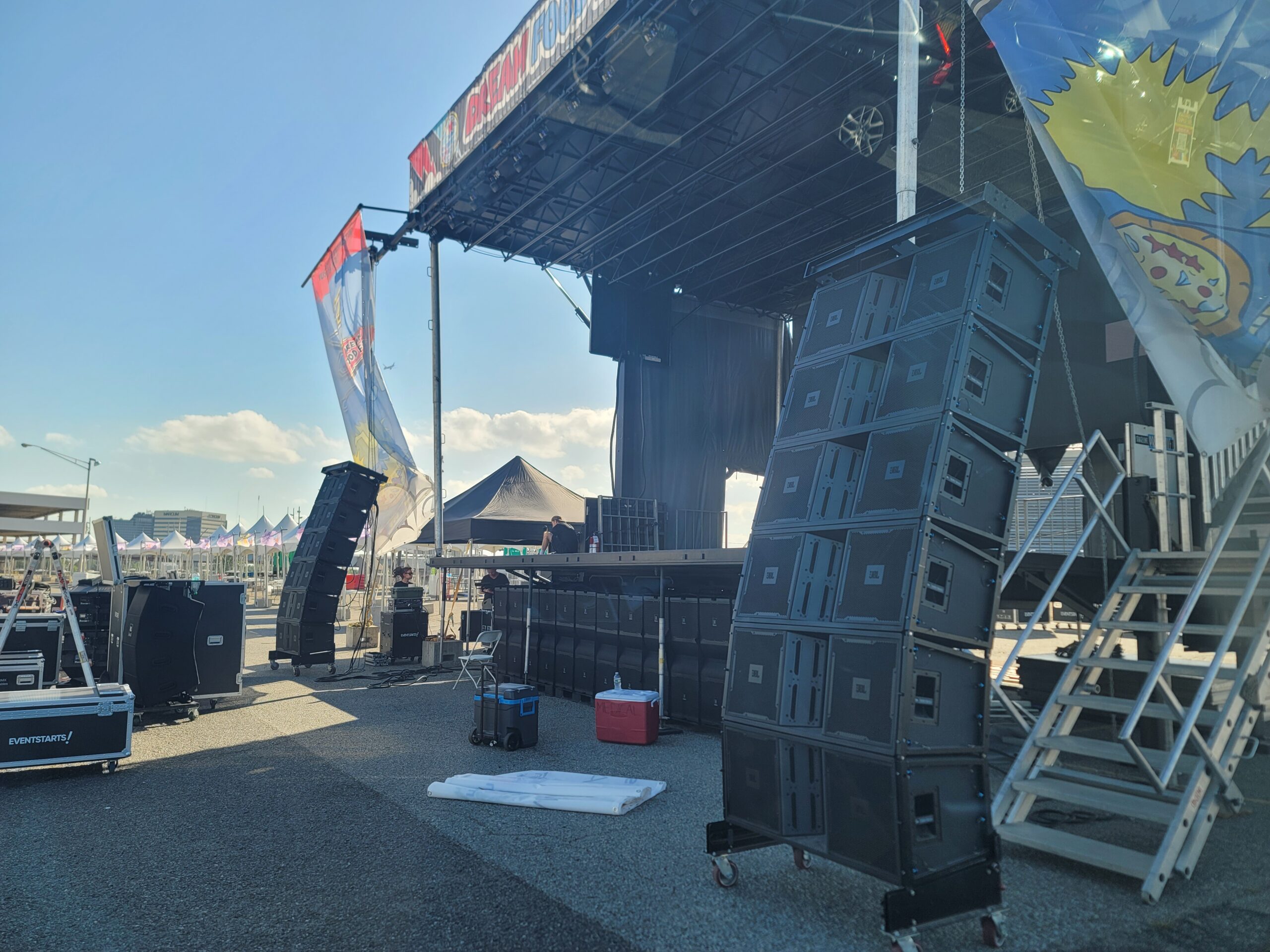
For a 75,000-person field deployment, standard practice places delay towers at intervals of 60 to 80 meters from front to back, each timed with enough additional delay to account for the distance from the main hang plus a Haas offset of 10–20 milliseconds. A 300-meter-deep field might require three delay positions: at 80m, 160m, and 240m. Each tower typically carries a line array sub-hang of 8–12 elements — systems like L-Acoustics KARA II, d&b V-Series, or JBL VTX A-Series — selected for their ability to deliver clean, focused coverage over a 60-meter throw without significant horizontal scatter that would create interference patterns with adjacent towers.
Structural Engineering: The Unsung Foundation of Tower Deployment
Every delay tower is also a structural engineering project. A self-climbing Layher tower system or StageCo delay structure loaded with 12 line array elements, two subwoofers, a delay fill system, lighting truss, and associated cabling can impose dynamic loads exceeding 2,000 kilograms at the top of a structure 14 meters above the ground. Engineers calculate wind load at both static and dynamic conditions — the Beaufort scale equivalent for the region and season — and specify foundation ballast, guy-wire configurations, and structural bracing accordingly.
Companies like Brilliant Stages, Tait Towers, and StageCo provide prefabricated delay tower structures with certified load ratings that allow audio rigging companies to hang speaker systems within defined weight limits without bespoke engineering on each show. This standardization has dramatically reduced the structural engineering overhead of major festival deployment — and the associated lead time — making it feasible to confirm delay tower layouts as late as three weeks before a show rather than the six-month lead time that bespoke structural design once required.
Digital Integration: From FOH to the Last Tower
The modern delay tower signal chain is a digital pathway from the first moment. At front of house, the system engineer feeds delay sends from a console — typically a Avid S6L, DiGiCo SD12, or SSL Live L650 — into a Lake Controller or d&b R1 network that manages all processing, EQ, and timing parameters for the entire distributed system. Fiber optic cable runs from the FOH position to each tower, converting back to AES3 digital audio at the amplifier rack before the final DA conversion in the Crown DCi Series or Lab.gruppen PLM amplifiers driving the speakers.
The fiber backbone has become the industry standard for large-scale PA distribution because it eliminates the electromagnetic interference that plagued analog multi-core runs at outdoor events — where ground loops, radio frequency interference, and the sheer inductance of 300-meter copper cable runs created noise floors that degraded the signal before it ever reached an amplifier. Fiber also dramatically reduces the cable weight and volume that touring crews must manage, making delay tower deployment at 75,000+ capacity shows a faster, lighter, and more reliable operation than the generation of engineers who wrestled with 300-meter analog multicore would recognize.
The Art of Invisible Engineering
The highest compliment an audience can pay a delay tower system is not to notice it. When the engineering is right — when the timing is perfect, the level tapering is smooth, and the tonal matching between the main hang and the delay positions is seamless — the 75,000-person field sounds like a single, coherent acoustic space. The performer’s voice arrives with presence, clarity, and emotional weight at every point in the field simultaneously. That illusion of uniformity, maintained across hundreds of meters by microsecond-precise digital timing and meticulously calibrated loudspeakers, is the quiet art at the heart of large-scale live event audio engineering.
