The Freedom of Light: Cutting the Last Cable
It is difficult to overstate how profoundly wireless LED fixtures have transformed the economics and creative possibilities of event production over the past decade. Before Astera — the Munich-based company founded in 2014 that almost single-handedly created the professional wireless LED tube and pixel fixture market — lighting a temporary structure, an outdoor architectural feature, a wedding reception marquee, or a corporate gala space required running power and DMX control cable to every fixture. The labor cost of cabling alone could account for 30–40% of the lighting budget on complex floor plans. Astera’s AX1 PixelTube, released in 2015, was the product that changed this equation permanently.
The AX1 PixelTube — a 1-meter RGBWA tube fixture with 10 individually controlled pixel zones, internal Li-ion battery offering 14+ hours of runtime, and both 2.4GHz wireless DMX and Art-Net wireless control built in — was not the first battery-powered LED fixture on the market. But it was the first to combine pixel control, broadcast-quality color reproduction, and professional reliability into a package that rental companies could actually build a business around. Within two years of its release, Astera PixelTubes appeared at Super Bowl pregame shows, Grammy Awards ceremonies, and flagship corporate product launches for brands including Apple, BMW, and Samsung. The fixture had become, almost immediately, a design staple.
The Astera Product Ecosystem: Titan, Helios, and Beyond
Astera’s commercial success with the AX1 drove rapid product expansion. The Astera Titan Tube — launched in 2019 — raised the performance ceiling dramatically, offering 16 individually controlled segments, RGBWAUV color mixing, improved wireless range, and a form factor that fit seamlessly into production lighting plots alongside wired fixtures. The Titan Tube became the go-to fixture for wide-angle background washes, architectural uplighting on a massive scale, and the kinetic wave effects that became a visual signature of touring shows by artists including Harry Styles, Billie Eilish, and The Weekend during the early 2020s.
The Astera Helios — a compact par-style fixture with a narrow beam profile — addressed a different production need: the requirement for wireless fixtures capable of sharp, directional output in corporate event environments where ceiling infrastructure is minimal, rigging points are unavailable, or the venue is architecturally protected and cannot be modified. For a product launch in a heritage building or a pop-up activation in a retail space, the Helios delivers the fixture density and control resolution of a traditional par rig without the cabling infrastructure that would make such deployments logistically impossible.
The AsteraApp and Wireless Control Workflow
Astera’s software ecosystem is as important as its hardware. The AsteraApp — available for iOS and Android — allows a single operator to address, test, group, and control up to 1,000 wireless fixtures from a single tablet interface, without requiring a dedicated lighting console for simple scenarios. For more complex productions, Astera fixtures integrate seamlessly with grandMA3, Chamsys MagicQ, and Avolites Titan platforms via Art-Net and sACN, allowing LDs to treat wireless fixtures identically to wired ones within their existing DMX universes and programming workflows.
The wireless control architecture uses the Astera 2.4GHz CRMX protocol — Lumen Radio’s professional wireless DMX standard — which provides interference-resistant, encrypted control with response latency below 2ms: effectively indistinguishable from wired DMX in live performance conditions. For large-scale deployments with many fixtures in close proximity, Astera’s AsteraBox acts as a dedicated wireless DMX transmitter that extends coverage and resolves the RF congestion that can occur in event environments where dozens of other wireless systems compete for spectrum.
Corporate Event Deployments: The Business Case for Wireless
The corporate event sector has adopted Astera wireless fixtures with particular enthusiasm because the value proposition extends beyond creative flexibility into hard production economics. A major product reveal for an automotive brand in a purpose-built temporary venue — the kind of deployment that might require lighting 200 individual structural elements from ground level — previously required hundreds of hours of electrician labor to run power and control cabling. With Astera fixtures, the same deployment might require a fraction of that labor, because each fixture is self-contained and the only infrastructure required is wireless DMX coverage.
Rental companies including Christie Lites, Neg Earth Lights, and 4Wall Entertainment have built substantial Astera inventories — with some operations holding hundreds of Titan Tubes and AX1 PixelTubes as core stock — precisely because the wireless format makes them uniquely deployable across the broadest range of event types and venues. A set of 50 Titan Tubes that light a concert stage floor on Friday can be repurposed for an outdoor architectural reveal on Saturday and a ballroom gala on Sunday, with no cable infrastructure changes between events. That versatility commands a rental rate premium that makes the capital investment economics compelling.
Music Events: Touring, Festivals, and the Pixel Era
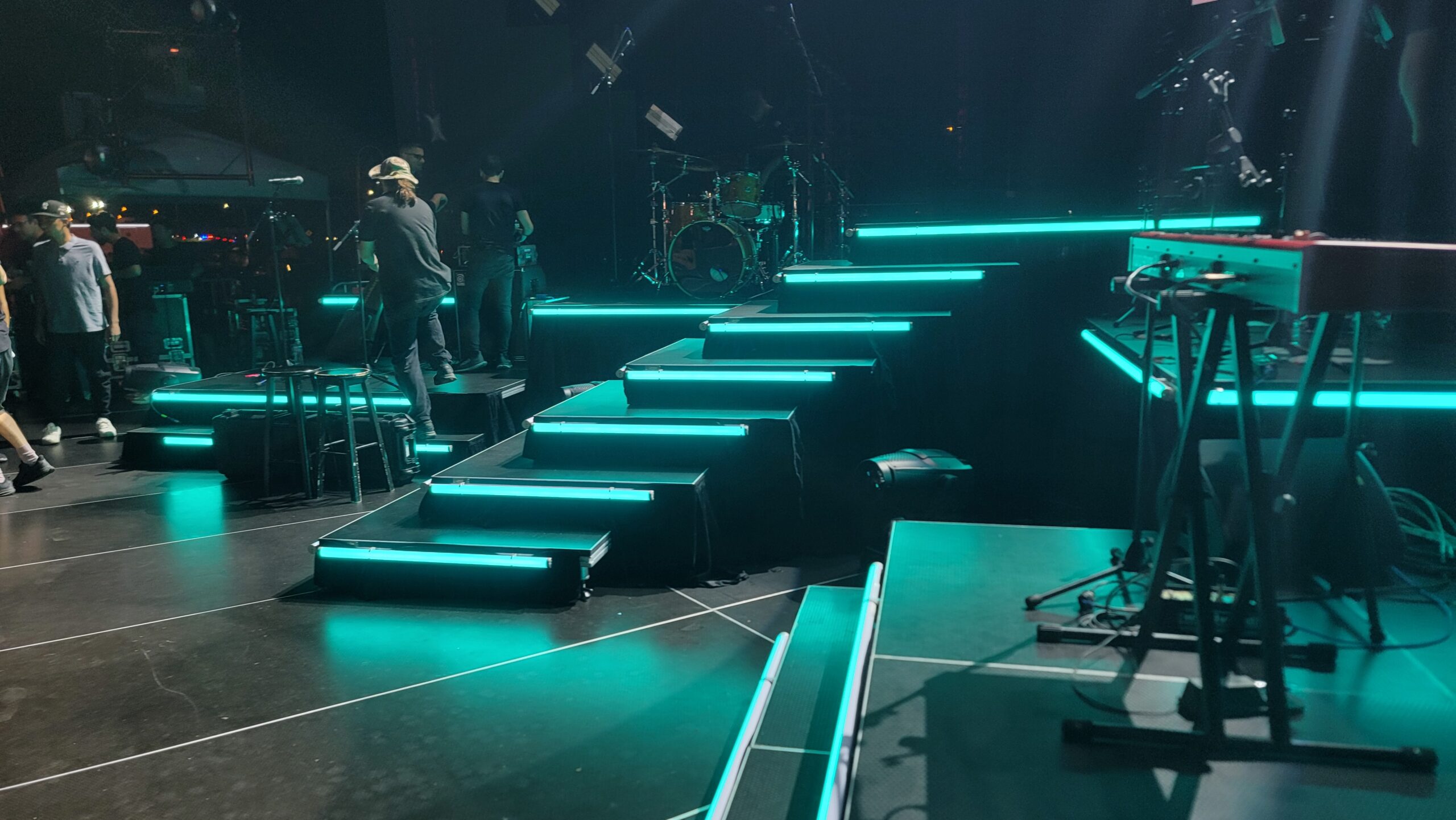
In the music touring world, Astera wireless fixtures have found their most visually dramatic applications in floor-level and set-piece positions where cable runs would be impractical or aesthetically unacceptable. Touring productions routinely deploy Titan Tubes as handheld performer props — a creative application that requires not just reliable wireless control but physical durability, since fixtures handled by performers in choreographed shows are subject to forces their production counterparts are not. Astera’s engineering teams have repeatedly cited durability testing as a primary development focus, with the AX1 PixelTube and Titan Tube both rated for continuous touring abuse that few comparable products can match.
From the corporate ballrooms of Geneva to the festival stages of Tokyo, Astera’s wireless LED revolution has genuinely rewritten what is possible in event lighting. The cable is gone. The creative constraints it imposed have vanished with it.
