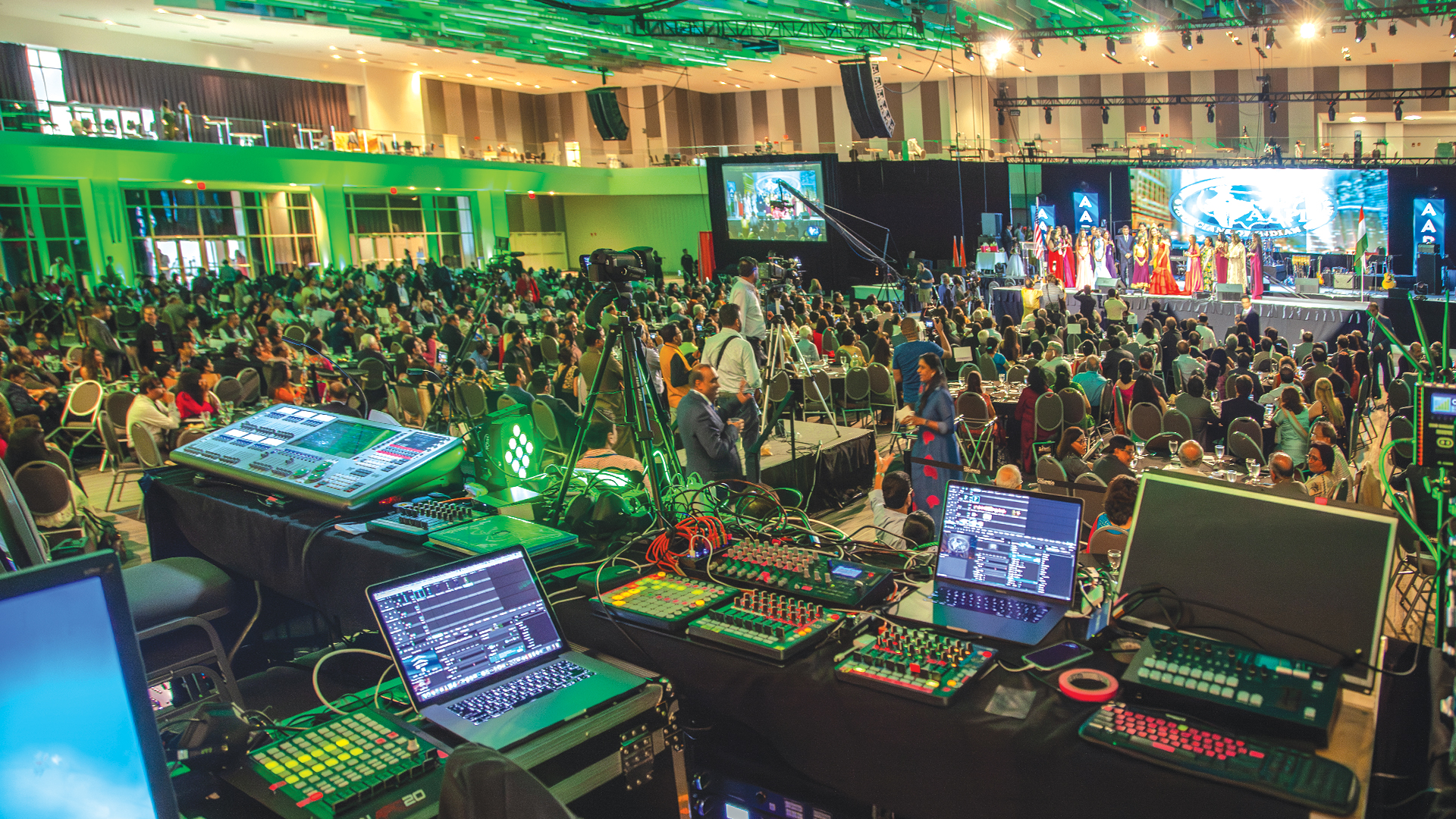
A large-scale live event is an exercise in coordinated complexity. On a single show, you might have an audio department managing 64-channel Dante audio network, a video department coordinating across presentation switching, media servers, and IMAG cameras, a lighting department programming 400 automated fixtures, a rigging team managing 60 chain hoists, a scenic department choreographing automated stage elements, and a streaming team managing a multi-platform live broadcast — all executing simultaneously, in real time, against a show rundown that may have changed three times in the past 24 hours. The capacity of a production to keep these departments synchronized — technically, operationally, and informationally — is what separates shows that run with machine precision from shows that visibly struggle through their own complexity.
The Shared Truth Problem: Rundown Management
Every department in a live event production operates from a show rundown — the sequential document that defines the order, content, and timing of every element in the program. When that rundown is version-controlled and universally current, the production machine operates from a shared understanding of reality. When it is not — when the show caller is working from v14 of the rundown, the lighting operator has v12, and the graphics team has v11 — the production machine is operating from conflicting maps of the same territory, and the collisions are inevitable.
Professional production organizations use cloud-based rundown management systems to maintain a single authoritative version of the show rundown that all departments access simultaneously. Platforms including Showflow, Flo, Cue Commander, and integrated modules within production management suites like Flex enable real-time rundown collaboration — when a change is made, every department sees the updated version immediately, with clear visual indicators distinguishing the new element from the previous version. This sounds like basic document management, but the discipline of implementing it consistently across every show is the organizational behavior that eliminates the most common category of multi-department synchronization failure.
Intercom Architecture for Multi-Department Coordination
Physical communication infrastructure is the nervous system of multi-department coordination. The intercom system design for a complex production must balance two competing needs: the ability of the show caller to reach any department instantly, and the ability of each department to communicate internally without their chatter contaminating every other department’s communication environment. Riedel Artist, Clear-Com Eclipse, and RTS ADAM matrix intercom systems solve this through programmable routing matrices that create isolated communication channels for each department while providing the show caller with override access to all channels simultaneously.
For productions where crew members are physically dispersed across a large venue, supplement the wired intercom infrastructure with digital radio systems — Motorola MOTOTRBO, Hytera DMR, or Kenwood ProTalk platforms provide encrypted, trunked digital radio communication with channel discipline equivalent to wired intercom. Assign radio channels by department with the same logic applied to wired intercom — a stage manager radio channel, a rigging channel, a client services channel — and brief all users on channel protocols before load-in begins.
Technical Synchronization: Clock, Timecode, and Show Control
Beyond human communication, multi-department synchronization has a technical dimension: the systems operated by different departments must share a common timing reference to execute simultaneous cues with frame-accurate precision. MIDI timecode (MTC) and SMPTE LTC (Linear Timecode) have traditionally served this role — a timecode stream generated by the show control system and distributed to lighting consoles, audio playback systems, video servers, and automated stage systems, enabling them to execute pre-programmed cues against a synchronized timeline.
Modern productions increasingly use show control platforms — Green Hippo Hippotizer with SHAPE timeline, Medialon Manager, Alcorn McBride V16x, and Watchout — to orchestrate multi-department cues through a single interface. These systems send OSC (Open Sound Control), Art-Net, MIDI, and RS-232 commands to disparate systems simultaneously, enabling lighting color changes, video transitions, audio cue triggers, and scenic movement to be launched from a single show control cue with sub-frame timing precision.
Pre-Show Cross-Department Rehearsal: The Synchronization Audit
No amount of planning eliminates the need for a full cross-department rehearsal at show speed. This rehearsal — commonly called a tech rehearsal or full dress — is the only opportunity to test the integration of all departments’ work against the actual show rundown, in the actual venue, with all systems operational. Every synchronization assumption made in pre-production gets validated or invalidated in this rehearsal, and every discrepancy discovered here is infinitely less costly than one discovered during the live event.
Document every discrepancy discovered during tech rehearsal in a shared notes platform accessible to all departments simultaneously — tools like Notion, Basecamp, or a shared production Google Sheet. Assign each note an owner and a status (open/closed), and review the open notes list at the top of every subsequent rehearsal call. A production team that closes every note before the show opens is a production team that has done the synchronization work properly.
The Show Caller as Synchronization Anchor
All technical systems, all communication infrastructure, and all rundown management tools ultimately serve one function: supporting the show caller in executing a clean, synchronized show. The show caller is the human synchronization point — the individual who translates the show rundown into a real-time sequence of verbal commands that simultaneously direct every department. Investing in show caller training, giving show callers genuine authority during show execution, and protecting their concentration during critical sequences is the highest-return investment a production can make in multi-department synchronization. The best systems in the world cannot compensate for a show caller who is unsupported, overridden, or operating without the confidence that comes from thorough pre-show preparation.
