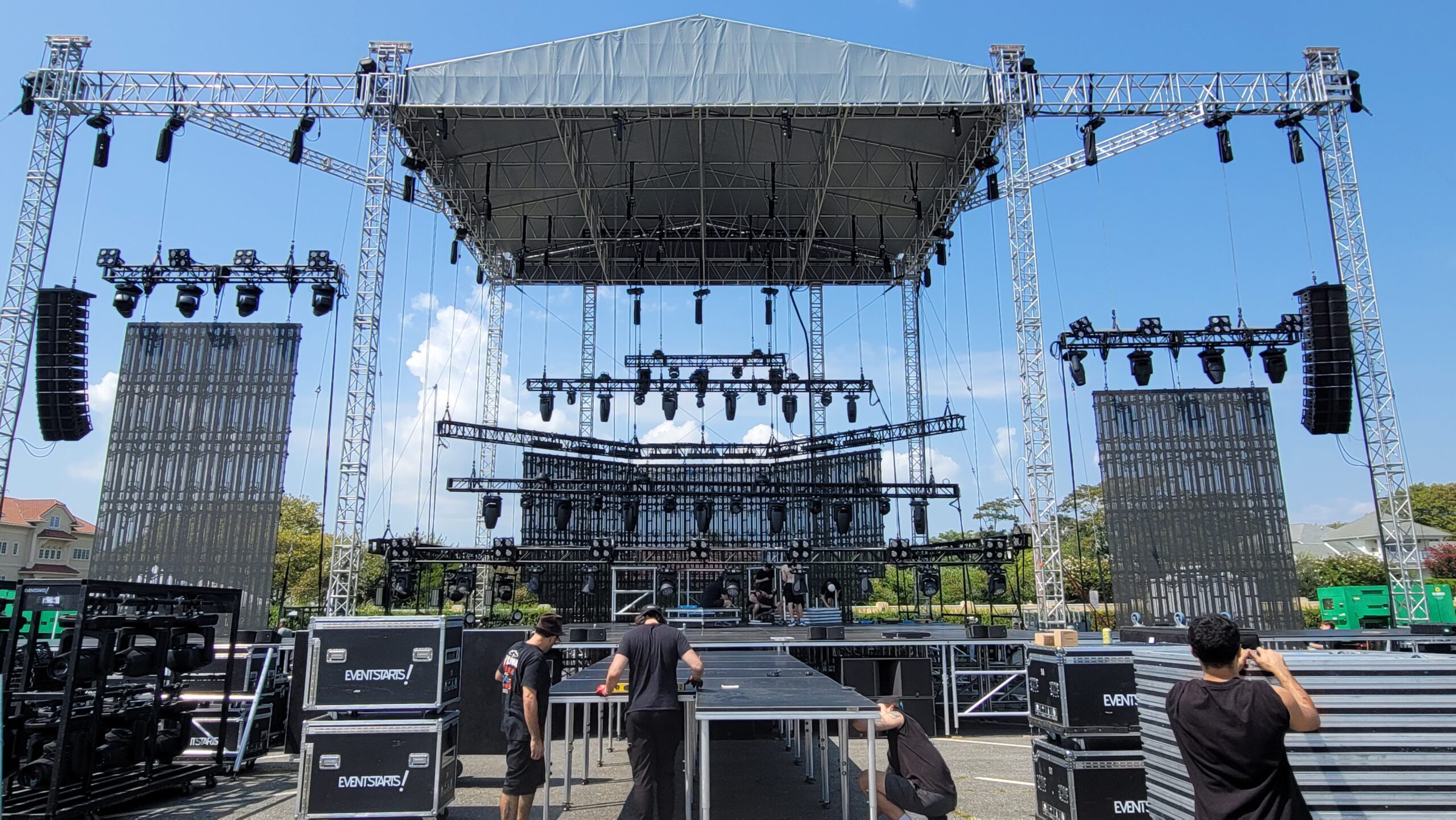
In the hierarchy of production nightmares, nothing quite compares to watching truss begin to move when it absolutely should not be moving. That slow, sickening moment when an ostensibly stable structure decides to explore new orientations—that’s the experience that keeps rigging crews obsessively checking calculations, inspecting hardware, and questioning every assumption about structural integrity.
Understanding Truss Engineering
Modern entertainment truss systems from manufacturers like Tyler Truss, Total Structures, and Global Truss are engineered to handle substantial loads when properly assembled and supported. A standard 12-inch box truss can support thousands of pounds in certain configurations. The key phrase is ‘properly assembled and supported.’
Truss distributes load through triangulated members—typically aluminum or steel tubes connected at nodes. This geometry creates tremendous strength for weight, but only when forces align with the structure’s design parameters. Loads applied perpendicular to the truss’s intended orientation, or point loads exceeding local capacity, can cause localized failures that cascade through the system.
The Evolution of Stage Rigging
Stage rigging has roots in maritime tradition. Nineteenth-century theaters employed sailors as stagehands because they understood rope systems, block and tackle arrangements, and the physics of lifting heavy objects. The hemp house rigging systems of that era used natural fiber rope to fly scenery—systems that required constant adjustment as rope stretched and environmental conditions changed.
The transition to counterweight systems in the early twentieth century improved reliability, but the real revolution came with aluminum truss in the 1970s. Rock and roll touring demanded portable structures that could support increasingly elaborate lighting and sound systems. Companies like Thomas Engineering (later James Thomas Engineering) pioneered modular truss designs that could be assembled, loaded, and struck quickly.
The Festival Disaster That Changed Everything
The Indiana State Fair stage collapse in 2011 remains the most significant rigging incident in American entertainment history. A severe wind gust struck the temporary stage structure before a Sugarland concert, causing catastrophic failure that killed seven people and injured over fifty. The tragedy transformed industry safety practices.
Post-incident analysis revealed multiple contributing factors: wind load calculations that didn’t account for gust dynamics, structural members operating near their limits, and inadequate weather monitoring protocols. The industry responded with new standards for temporary outdoor structures, including the ANSI E1.21 standard for entertainment industry portable roof systems.
Now, outdoor productions routinely include real-time weather monitoring with predetermined wind speed thresholds. Productions using systems like the DTN weather service receive advance warnings that trigger safety protocols. The willingness to cancel or evacuate has increased dramatically—no production is worth lives.
Ground Support vs. Flying Systems
Ground support systems—truss structures that stand on bases rather than hanging from building infrastructure—present unique stability challenges. A ground support PA tower might reach forty feet tall, with loudspeakers, rigging hardware, and cabling creating substantial loads that must be balanced around the support footprint.
Manufacturers like Milos, Prolyte, and Area Four Industries produce ground support systems with engineered base plates that distribute load across the support surface. However, these systems assume certain floor conditions. A venue floor with inadequate load capacity, or an outdoor site with soft ground, can allow bases to sink or shift—introducing the dreaded movement that precedes failure.
Flying systems depend on venue infrastructure, transferring loads to building steel or rigging points. The relationship between chain hoists, beam clamps, and building structure requires careful engineering. CM Lodestar and Prolyft Aetos motor systems provide precise lifting control, but they can’t overcome inadequate attachment points.
Real-World Stability Failures
I’ve witnessed truss stability issues ranging from minor scares to genuine emergencies. The most instructive occurred at an indoor corporate event where a ground support lighting truss began visibly swaying during load-in. Initial assumption: someone was moving a fixture above. Investigation revealed the actual cause: the venue’s air conditioning system had cycled on, creating a pressure differential that was actually moving the structure.
The swaying was minor—perhaps an inch of movement at the thirty-foot height—but it revealed an inadequately braced system. The production’s rigger had calculated loading correctly but hadn’t accounted for horizontal forces. Additional guy wires stabilized the structure, but the incident highlighted how environmental factors beyond obvious concerns like wind can affect truss systems.
Outdoor events face exponentially more variables. Ground conditions change with weather—a site survey conducted during dry conditions might not reveal how the substrate behaves after rain. Thermal expansion affects aluminum differently than steel; mixed systems can develop stresses as temperature varies throughout a day.
Best Practices for Truss Safety
Professional rigging operations follow established safety protocols that have evolved through decades of experience and, unfortunately, learning from failures. Every ETCP-certified rigger understands that safety factors exist for reasons they account for unknowns, dynamic loading, and the accumulated degradation that affects all structural systems over time.
Documentation matters enormously. Structural engineering calculations should be performed for every non-standard configuration. The Production Resource Group and similar major vendors employ staff engineers who provide calculations for complex builds. These calculations should be retained and available for inspection throughout the production.
Hardware inspection protocols catch developing problems before they become failures. Pin locks should engage fully; half-engaged pins represent connection points operating at reduced capacity. Shackles should be properly rated and installed with pins secured against rotation. Wire rope clips must be installed in correct orientation with proper torque.
The Role of Professional Certification
The ETCP (Entertainment Technician Certification Program) certification for rigging represents the industry’s commitment to professional standards. ETCP-certified riggers have demonstrated knowledge of structural principles, hardware specifications, and safety protocols through rigorous examination.
Certification doesn’t guarantee competence—experience matters too—but it establishes a baseline of knowledge. Many venues now require ETCP certification for lead riggers on complex productions. Insurance requirements increasingly reference certification as a condition of coverage.
Continuing education keeps certified professionals current with evolving technology and standards. The ESTA Technical Standards Program continuously develops new guidelines addressing emerging equipment and practices. The industry’s willingness to learn from incidents and codify that learning into standards has dramatically improved safety over the past two decades.
When Things Go Wrong
Emergency response to truss stability issues requires immediate assessment and decisive action. If truss is moving unexpectedly, the first priority is clearing the area beneath. People can be replaced; structures can be rebuilt; lives cannot be restored.
Secondary assessment determines whether the movement is ongoing or has stabilized. A structure that has shifted to a new equilibrium might remain stable if undisturbed. A structure with ongoing movement—progressive failure—requires evacuation of the surrounding area and potentially the entire venue.
Professional response includes documentation for incident analysis. Photos and videos captured during and after incidents provide crucial information for understanding what failed and why. This information improves future safety and may be required for insurance or legal purposes.
The truss systems that refuse to stay upright teach the most important lesson in production rigging: gravity is always working, and it doesn’t negotiate. Every structure exists in a battle against forces that will eventually win. Our job is to design, build, inspect, and monitor to ensure that victory comes long after our show has ended and the equipment has been safely struck.
